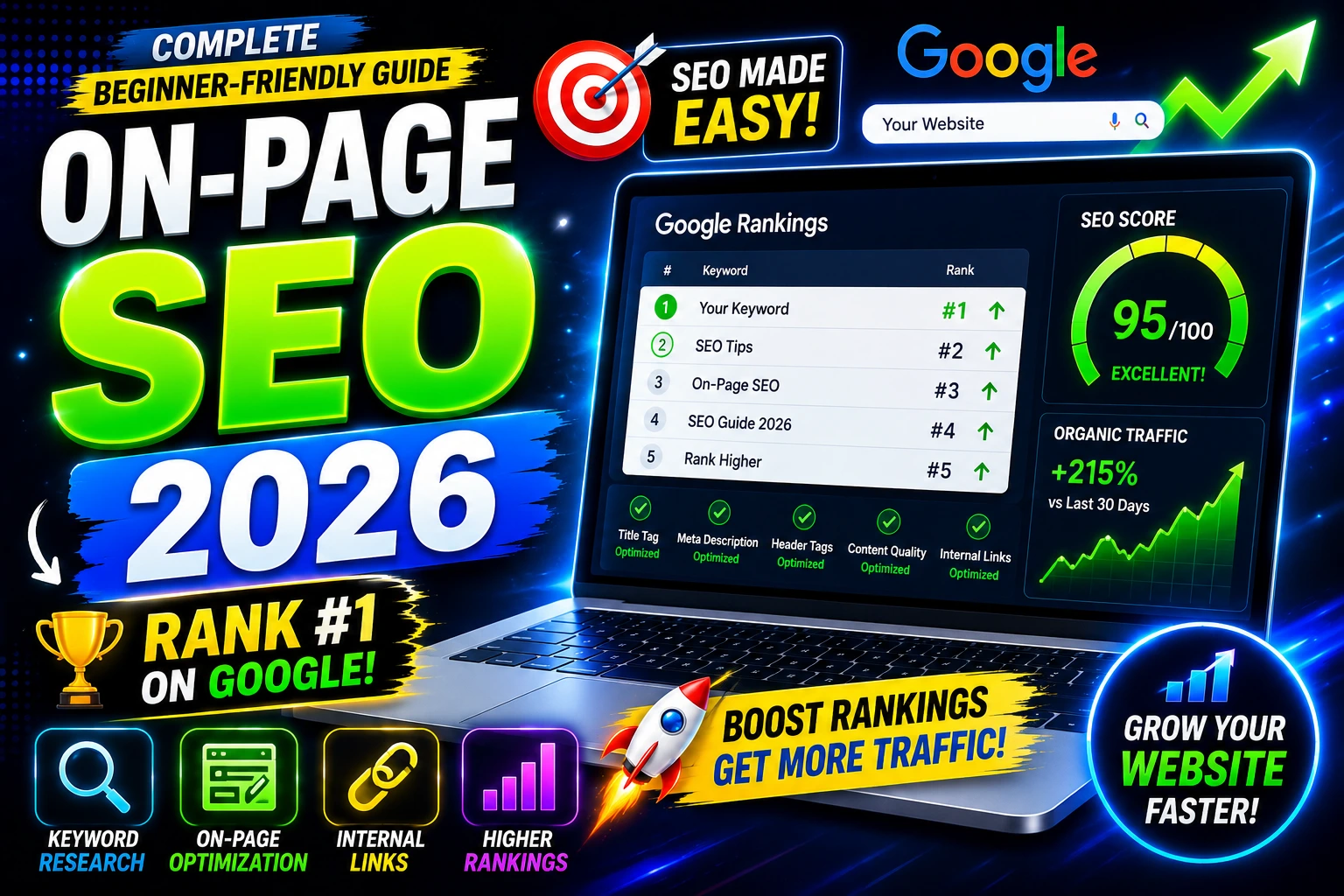
On-Page SEO Guide 2026 (Complete Beginner-Friendly Guide to Rank Higher on Google)
Introduction
On-page SEO is one of the most important parts of website ranking in 2026. If your content is properly optimized, your website can appear higher in Google search results and attract more visitors.
Many beginners create websites and publish articles, but they do not understand how to optimize content correctly. As a result, their pages do not rank well and they receive very little traffic.
In this complete guide, you will learn what on-page SEO is, why it matters, and how to optimize your articles step by step. This article is written in simple English, detailed format, and follows AdSense-friendly content guidelines.
What is On-Page SEO?
On-page SEO means optimizing the content and structure of your website pages to improve rankings on search engines like Google.
👉 Simple Example:
If your article title, headings, keywords, images, and links are properly optimized, Google can better understand your content.
On-Page SEO Guide 2026
Search engine optimization changes fast, but one thing remains constant: On-Page SEO Guide 2026 (Complete Beginner-Friendly Guide to Rank Higher on Google) is your roadmap to organic visibility. If you’re new to SEO or need a fresh perspective for the coming year, this guide breaks down everything you need—without the confusing jargon.
In 2026, Google’s algorithms prioritize user experience, intent matching, and content depth more than ever. On-page SEO isn’t just about sprinkling keywords anymore. It’s about crafting pages that genuinely answer questions, load instantly, and guide visitors smoothly. Let’s dive into the actionable steps that will help your content rank higher, starting today.
What Is On-Page SEO and Why Does It Matter in 2026?
On-page SEO refers to optimizing individual web pages to improve search rankings and attract relevant traffic. Unlike off-page SEO (backlinks, social signals), on-page factors are 100% within your control. In 2026, Google’s AI—often called the “Search Quality Enhancer”—rewards pages that demonstrate E-E-A-T (Experience, Expertise, Authoritativeness, Trustworthiness) and satisfy search intent immediately.
Beginners often worry about technical complexity, but modern on-page SEO follows a logical flow: create helpful content, make it easy to read, ensure fast delivery, and prove your credibility. Get these right, and you’ll outrank competitors with older, slower, or less relevant pages.
Step 1: Master Search Intent Before You Write a Single Word
The first rule of the On-Page SEO Guide 2026 (Complete Beginner-Friendly Guide to Rank Higher on Google) is understanding why someone searches. Search intent falls into four categories:
Informational – “how to fix a leaky faucet”
Navigational – “Facebook login”
Commercial – “best running shoes for flat feet”
Transactional – “buy Nike Air Zoom online”
For beginners, always check Google’s first page for your target keyword. If all results are listicles (“10 Best…”), a single long-form guide probably won’t rank. Match your format to what’s already working. In 2026, Google uses intent shifting signals—if users quickly return to search results, your content misaligned with their goal.
Step 2: Optimize Title Tags and Meta Descriptions for Clicks
Your title tag is the bold, clickable headline in search results. Keep it under 60 characters, include your primary keyword naturally, and spark curiosity or urgency. For example: “On-Page SEO 2026: 9 Beginner Tips to Rank Higher” works better than a generic “SEO Tips.”
Meta descriptions (up to 160 characters) don’t directly boost rankings, but they heavily influence click-through rates (CTR). In 2026, Google sometimes rewrites meta descriptions to match query context, so write clear, benefit-driven sentences. Use active voice and include a subtle call-to-action like “Learn how” or “Get started.”
Step 3: Create High-Quality, Comprehensive Content (Updated for 2026)
Google’s helpful content system now operates in real time. Pages that simply rephrase existing information get demoted. Your content must add unique value. For a beginner-friendly on-page SEO guide, that means:
Answer follow-up questions – Use “People also ask” boxes and related searches to find subtopics.
Update statistics and examples – Outdated data hurts trustworthiness.
Include original media – Screenshots, charts, or short videos made by you signal effort.
Write at a reading level suitable for your audience – Avoid fluff. Break complex ideas into bullet points or numbered steps.
Aim for depth, not length. A 1,500-word article that fully satisfies intent outperforms a 5,000-word ramble. In 2026, content efficiency—information density per scroll—is a ranking factor.
Step 4: Smart Keyword Placement (No More Stuffing)
Keywords still matter, but naturally. Follow this pattern for each page:
First 100 words – Include your primary keyword once.
Headings (H2, H3) – Use variations where logical.
Image alt text – Describe the image using relevant terms.
URL slug – Short, keyword-rich (e.g., /on-page-seo-guide-2026).
Last paragraph – One natural mention for closure.
LSI keywords (semantically related terms) help Google understand context. For an on-page SEO guide, related terms might be “internal linking,” “mobile responsiveness,” and “schema markup.” Sprinkle them conversationally.
Step 5: Structure for Readability and Featured Snippets
In 2026, over 40% of searches show zero-click answers—especially featured snippets, “People also ask,” and AI overviews. To win these:
Use clear, direct H2 and H3 subheadings.
Answer specific questions in paragraphs of 40–60 words under a heading.
Format lists, steps, or tables for easy extraction.
Add a “Key Takeaways” or “Summary” box at the start or end.
Readability affects dwell time (how long users stay). Short sentences, subheadings every 2–3 paragraphs, and ample white space keep readers engaged. Google’s “dwell time” signal in 2026 is stronger than ever—if users bounce back to results, your ranking drops.
Step 6: Internal Linking That Distributes Link Equity
Internal links connect your pages, helping Google discover content and understand site structure. For beginners, a simple rule: every new page should receive at least 2–3 internal links from relevant existing pages. Use descriptive anchor text (e.g., “learn more about keyword research basics”) rather than “click here.”
In 2026, internal linking also influences topic clustering. Group related articles under a “pillar page”—a comprehensive guide that links to supporting posts. This signals authority to Google.
Step 7: Core Web Vitals and Mobile-First Experience
Page experience is non-negotiable. Core Web Vitals measure loading speed (Largest Contentful Paint under 2.5 seconds), interactivity (First Input Delay under 100ms), and visual stability (Cumulative Layout Shift under 0.1). Use Google’s PageSpeed Insights to test your site.
Since 2021, Google has used mobile-first indexing, meaning it ranks your mobile version. In 2026, tablet and foldable device experiences also matter. Check that text is readable without zooming, buttons are tappable, and pop-ups don’t block content.
Step 8: Image Optimization and Emerging Media
Images slow down pages if not optimized. Compress JPEGs/WebP files, set width and height attributes to prevent layout shifts, and use descriptive filenames (on-page-seo-checklist.png instead of IMG_123.png).
In 2026, Google also indexes video transcripts and audio snippets. Adding a short video summary or podcast-style audio version can earn rich results. Always provide a transcript for accessibility and SEO.
Step 9: Structured Data (Schema Markup) Made Easy
Structured data helps Google understand your page’s context. For a beginner guide, apply HowTo schema (if step-by-step), FAQ schema (for common questions), or Article schema (for blog posts). You don’t need to code—plugins like RankMath or Schema Pro handle it.
Testing is simple: use Google’s Rich Results Test tool. Valid schema increases chances of appearing with stars, images, or expandable FAQs.
Step 10: Monitor, Update, and Improve
On-page SEO isn’t a one-time task. Google’s algorithms update thousands of times per year. Set a quarterly reminder to:
Check ranking positions for your main keywords.
Update outdated facts, links, and examples.
Add new FAQs based on search query trends.
Review Core Web Vitals after site changes.
Tools like Google Search Console (free) show which pages have impressions but low CTR—perfect opportunities to rewrite meta descriptions or add compelling subheadings.
Common Beginner Mistakes to Avoid in 2026
Ignoring AI overviews – Google’s AI-generated answers appear above organic results. Optimize for them by writing concise, factual definitions.
Over-optimizing anchor text – Exact-match internal links look unnatural. Vary phrases.
Forgetting about accessibility – Alt text, good contrast, and keyboard navigation help rankings (and users).
Chasing volume over intent – A keyword with 100 monthly searches but high purchase intent beats a 10,000-volume informational term.
Final Thoughts: Your Action Plan
The On-Page SEO Guide 2026 (Complete Beginner-Friendly Guide to Rank Higher on Google) boils down to this: build pages that satisfy searchers better than anyone else. Start with intent research, write clear and helpful content, optimize for speed and mobile, then connect pages through smart internal linking.
Don’t try to perfect everything at once. Pick two or three actions from this guide—fix your title tags, improve one page’s readability, or add schema markup. Measure the impact over four weeks. SEO is a marathon, but every small win compounds.
Google’s goal is to reward the most useful answer. Your goal is to become that answer. With this beginner-friendly roadmap, you have everything you need to start ranking higher in 2026—no prior experience required.