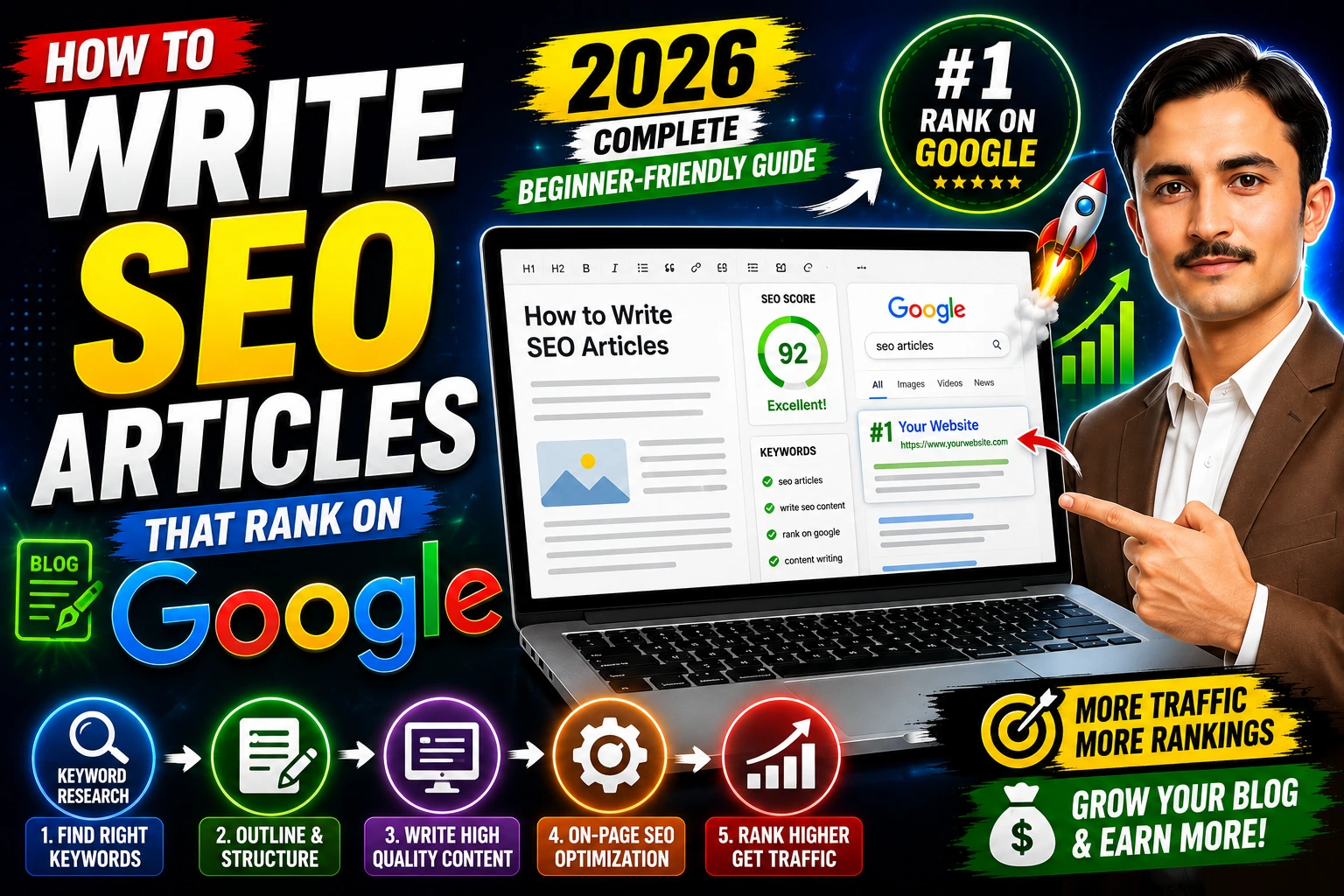
How to Write SEO Articles That Rank on Google (2026 Complete Beginner-Friendly Guide)
Introduction
Writing an article is easy, but writing an SEO article that ranks on Google is different. In 2026, Google focuses more on content quality, user experience, and helpful information.
Many beginners publish articles every day, but their content never appears on the first page of Google because they do not follow proper SEO writing techniques.
The good news is that anyone can learn SEO writing step by step.
In this complete guide, you will learn how to write SEO articles that rank on Google, attract traffic, and improve your AdSense approval chances. This article is written in simple English, beginner-friendly style, and follows modern SEO practices.
What is an SEO Article?
An SEO article is a piece of content optimized for search engines and users.
👉 Simple Example:
If someone searches:
“How to start blogging”
And your article appears on Google: ➡️ That means your content is SEO optimized.
How to Write SEO Articles That Rank on Google (2026 Complete Beginner-Friendly Guide)
In the ever-evolving world of digital marketing, one question remains constant: How do I get my content to the first page of Google? As we navigate through 2026, the rules of search engine optimization have matured, but the core principles are more accessible than ever. If you are new to this game, do not be intimidated. This How to Write SEO Articles That Rank on Google (2026 Complete Beginner-Friendly Guide) will walk you through every single step, from keyword research to hitting “publish.”
Gone are the days of keyword stuffing and shady backlinks. In 2026, Google’s AI, often referred to as the “Experience, Expertise, Authoritativeness, and Trustworthiness” (E-E-A-T) system, rewards genuine value. Let’s break down exactly how you, a complete beginner, can write articles that not only rank but actually help your readers.
Understanding the 2026 SEO Landscape
Before typing a single word, you must understand what Google wants in 2026. The search engine now prioritizes search intent over everything else. This means Google asks: Does this article solve the user’s problem?
In this How to Write SEO Articles That Rank on Google (2026 Complete Beginner-Friendly Guide), we operate on one truth: content written for humans first will always outrank content written for robots. However, you still need to help Google understand your human-centric content. That is the art of modern SEO.
Step 1: Finding Your “Golden” Keywords
You cannot rank for thin air. You need a topic. For beginners, the best approach is “Long-Tail Keyword” research. These are phrases of 4+ words that have low competition but high intent.
For example, instead of trying to rank for “SEO” (impossible for a beginner), try “how to optimize a blog post for local SEO.” Use free tools like Google Autocomplete, AnswerThePublic, or Ubersuggest. When you find a keyword, ask yourself: Is the search result filled with forums or guides? If it is mostly Reddit or Quora, you have found a goldmine of questions to answer.
Remember to bold your primary keyword where appropriate, but keep it natural. A 2026 algorithm detects unnatural repetition instantly.
Step 2: Decoding Search Intent (The Secret Sauce)
Here is where most beginners fail. You cannot just write an article; you must match the “format” of the top 3 results on Google.
Informational Intent: The user wants to learn. Your article should be a guide, listicle, or tutorial.
Commercial Intent: The user wants to buy or compare. Your article needs reviews or “best of” lists.
Transactional Intent: The user wants to sign up or purchase immediately.
For this How to Write SEO Articles That Rank on Google (2026 Complete Beginner-Friendly Guide), we are writing for “Informational Intent.” You want to teach. Go to Google, type your topic, and look at the “People Also Ask” boxes. Those questions become your subheadings.
Step 3: Structuring Your Article for Featured Snippets
In 2026, zero-click searches (where the answer appears directly on Google) are the norm. To rank, you want to capture the “Featured Snippet” – that box at the top of the page.
To do this, use clear, bolded subheadings (H2s and H3s) and answer specific questions immediately after them. Use bullet points and numbered lists. For instance, if someone searches “steps to write SEO articles,” your list should start directly below the H2. Google’s bots love scannable content.
Using the structure of a How to Write SEO Articles That Rank on Google (2026 Complete Beginner-Friendly Guide), we break complex topics into digestible 200-word chunks. Short paragraphs (1-3 sentences max) are a must for mobile readers.
Step 4: Writing the “Un-Ignorable” Headline (Title Tag)
Your title is your first impression. It must include your primary keyword (as we did above) and a power word. In 2026, click-through rate (CTR) is a direct ranking signal.
Bad Title: SEO Article Tips
Good Title: How to Write SEO Articles That Rank on Google (2026 Complete Beginner-Friendly Guide)
Notice the parenthesis and the year. Adding “2026” signals freshness. Adding “Beginner-Friendly” lowers the barrier to entry. Keep your title under 60 characters so it displays fully on mobile.
Step 5: Optimizing the Introduction (The Hook)
You have 5 seconds to convince the reader (and Google) to stay. This is called “Dwell Time.” If users click your link and immediately bounce back to Google, your ranking drops.
Your first 150 words must promise a solution. Start with a pain point (e.g., “Tired of writing articles that no one reads?” ) and immediately state the benefit of finishing your guide. Within the first paragraph, naturally bold your main keyword to signal relevance, but ensure the sentence flows like human speech.
Step 6: Internal and External Linking Strategy
A page with no links is a “dead end” in Google’s eyes.
Internal Links: Link to other articles on your own website. If you have a guide on “Keyword Research,” link to it here. This keeps users on your site longer.
External Links: Link to high-authority sources (like HubSpot, Backlinko, or Google’s own documentation). This proves you did your research. Do not be afraid to send people away; Google sees this as good “internet citizenship.”
In the context of this How to Write SEO Articles That Rank on Google (2026 Complete Beginner-Friendly Guide), you should link to free tools that help beginners, such as Google Search Console or Yoast SEO.
Step 7: On-Page Optimization (Meta Descriptions & Alt Text)
These are the technical touches that polish your work.
Meta Description: The small blurb under your link on Google. It does not directly affect rankings, but it does affect clicks. Write a compelling 150-character summary including your main keyword.
Image Alt Text: Every image you upload needs a description. If you have a screenshot of a Google search, the alt text should be “Beginner following this How to Write SEO Articles That Rank on Google (2026 Complete Beginner-Friendly Guide).” This helps you rank in Google Images, which drives extra traffic.
Step 8: The “Readability” Factor
You are writing for tired, busy people. Use the Hemingway method:
Short sentences.
Active voice. (“Write articles” not “Articles are written by you.”)
Transition words. (However, therefore, for example.)
Bold key phrases (like we have been doing) to break the visual monotony, but do not overdo it.
If your reader squints or feels confused, they leave. Google tracks “pogo-sticking” (clicking a result and immediately going back). High readability guarantees they stay.
Step 9: Updating and Refreshing (The 2026 Hack)
Here is a secret that costs nothing but yields huge results: Freshness. An article published in 2023 that is updated in 2026 will outrank a brand new article with the same information.
Google’s crawlers look for “Last Updated” timestamps. Two weeks after you publish this How to Write SEO Articles That Rank on Google (2026 Complete Beginner-Friendly Guide), come back and add a new paragraph about a recent Google update or a new tool. Change the publish date to “Updated 2026.” You will often see a 20% traffic spike just from this action.
Step 10: Measuring Your Success (Google Search Console)
You cannot fix what you do not measure. Set up free Google Search Console. Look at two metrics:
Impressions: How many people see your link.
Average Position: Where you rank (1 is best).
If you have impressions but low clicks, your title or meta description is weak. If you have no impressions, Google has not indexed your page, or you chose a keyword that is too competitive.
Common Beginner Mistakes to Avoid in 2026
Ignoring Mobile: 70% of searches happen on phones. If your font is tiny or your images are huge, you will not rank.
AI-Generated Fluff: While AI tools help with outlines, Google detects “low-effort” AI content. You must add personal anecdotes, case studies, or original data.
Over-Optimizing the Keyword: Using the phrase How to Write SEO Articles That Rank on Google (2026 Complete Beginner-Friendly Guide) 50 times in the article will trigger a “Spam” penalty. Use synonyms like “SEO writing tactics” or “Google ranking strategies.”
Conclusion: Your First Step Today
You do not need a degree in marketing to succeed at SEO in 2026. You need patience, a willingness to help, and this framework. Remember that this How to Write SEO Articles That Rank on Google (2026 Complete Beginner-Friendly Guide) is a living document. The principles here will work today, tomorrow, and for the foreseeable future.
Start by writing a 1,000-word article using the steps above. Publish it. Wait three days. Then, update it with a new paragraph. By the end of the month, you will likely see your first organic visitor from Google. That visitor is proof that the system works. Now, open a blank document, find a long-tail keyword, and begin your first SEO-optimized article. The first page of Google is waiting for you.